
Public Louisiana Arrest Records
Access usually comes down to the record type and any legal exception. Louisiana's Public Records Law takes a broad view of what counts as public. Its law-enforcement exception shields investigative material. Booking records and initial reports stay open, though. That split matters in practice. A current roster, an arrest report, a booking photo, a court minute entry, and a closed investigative file are different records. Each has its own source, purpose, and access rule.
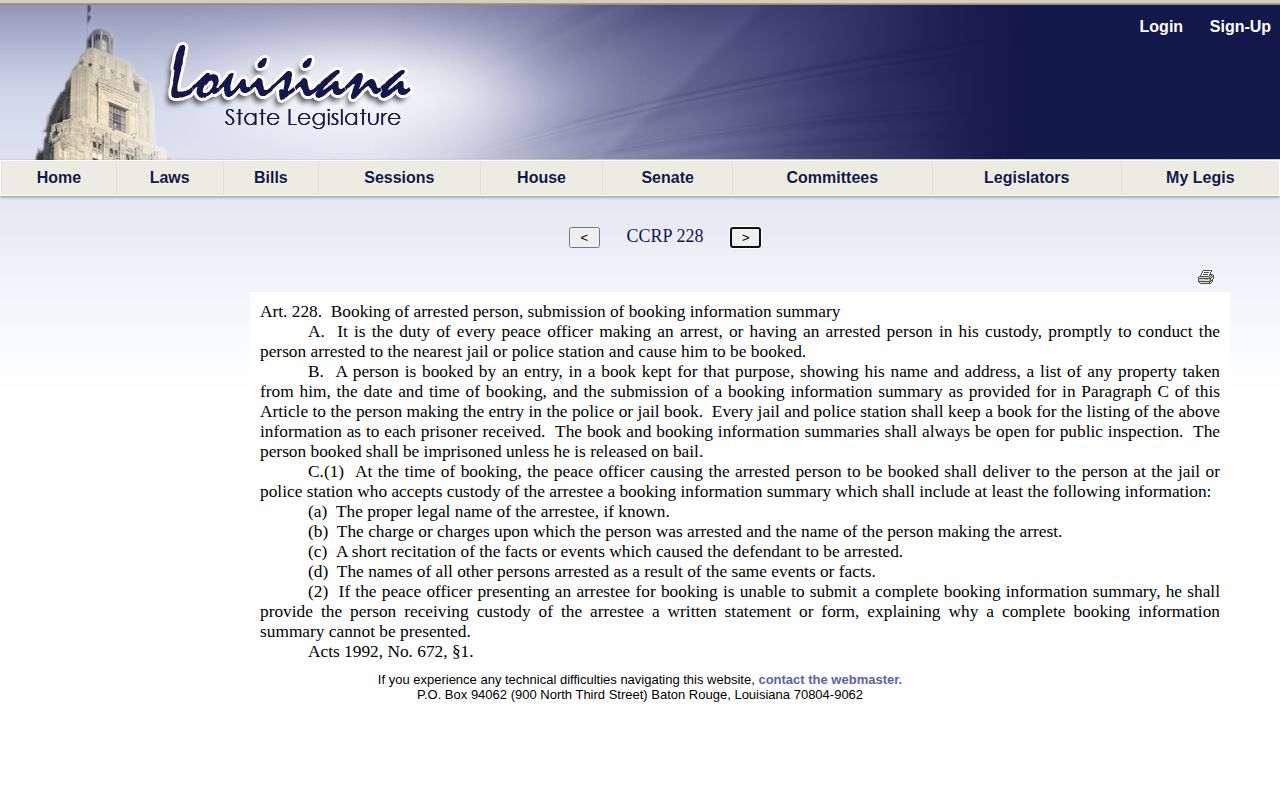
Code of Criminal Procedure article 228 sets the booking rule. A warrantless arrest requires prompt booking. The statute says the person goes promptly to a jail or police station for it. The booking book and the booking-information summary are open to public inspection. The summary carries real detail. It lists the arrested person's name when known. The charges, the arresting person, and brief facts appear there as well. Names of others arrested in the same event appear too.
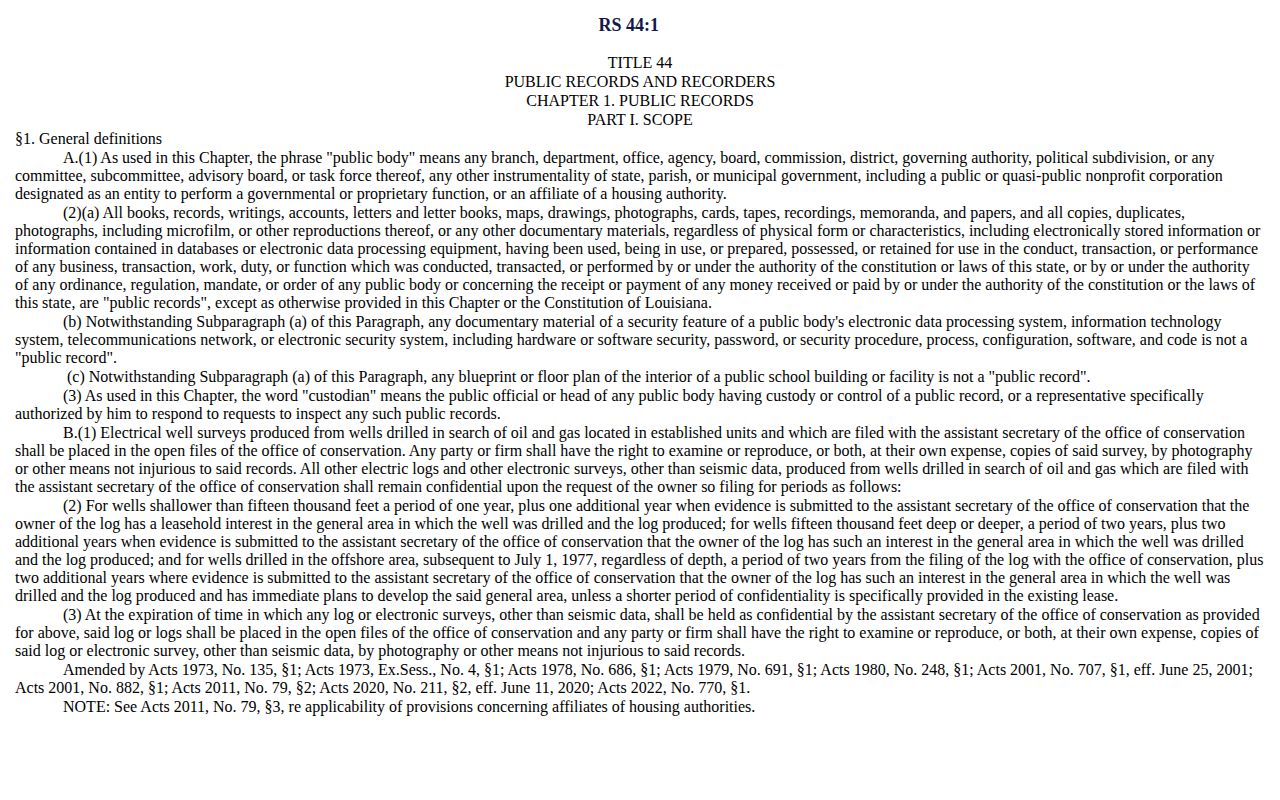
The public-records definition appears in R.S. 44:1 at the Louisiana Legislature site. It is a statute source, not a case record.
The full text of article 228 sits with the Legislature. It spells out what belongs in the booking book and summary.
Note: Public access describes a record’s legal status; it does not make the allegation a court finding or guarantee every field is online.
Louisiana Public-Record Boundaries
R.S. 44:3 draws the main line for law-enforcement files. Certain records stay confidential under it. Booking records and the first report remain open. An agency may have to withhold investigative detail, confidential sources, protected personal facts, or material tied to an open inquiry. Even then, a denial of one part does not settle whether a separate booking entry or other public portion can be released.
A good request starts narrow. Name the agency and ask for the specific record that answers the question. Include the person's name and parish. Add the arrest or booking date, a date range, a case or incident number, and the format you want, when known. Ask the custodian to cite the legal basis for anything withheld. Also request any separable public portion. Louisiana has no statewide arrest-photo database, so a broad demand for one will not produce a record.
State request rules cover inspection, copies, and how a custodian handles the matter. R.S. 44:32 governs public access and copy costs. Related provisions offer a path when access is disputed. Inspection is generally free. A lawful copy fee may apply, set by the custodian and the record, with no fixed statewide fee or universal response deadline.
- Identify the agency that made the arrest or holds the jail booking record.
- Ask for the narrow record and date range, and include identifiers that help the custodian locate it.
- State whether you want inspection or a copy, and ask for an estimate if copying or retrieval may cost money.
- If the agency withholds material, ask for the specific exemption and any reasonably separable portion that can be released.
A roster does not have to include a photo. Local listings vary. One may show a text entry, a booking photo, a current-custody list, or nothing online at all. Ask for the underlying booking record if that is the item you need. Direct the request to the right custodian. LSP releases and parish jail systems answer different questions, and the office that created or keeps the record is the one to ask.
Where Louisiana Arrest Records Remain
No single search box covers every record. Parish sheriff and jail rosters handle current custody. Some add a booking photo where local policy allows. Even so, a roster can miss a person who was released, a booking still being entered, or an older arrest. Louisiana State Police publishes event and enforcement news, not a statewide jail roster. The court side sits elsewhere.
Parish clerks and the Louisiana Clerks of Court Remote Access Authority hold records that may show a later minute entry or disposition rather than the first booking account. The statewide start is Louisiana recent arrests and the photo landscape. That hub gathers parish arrest feeds, booking photos, warrants, and their official sources. Search results are not complete files. Trace the source that holds the record.
| Question | Best-matched source | Limit to keep in mind |
|---|---|---|
| Who is in a parish jail now? | The parish sheriff or jail roster, or LA VINE custody search. | Current custody is not the same as the full arrest history. |
| What was booked? | The agency’s booking book, summary, or arrest report. | Some investigative or protected details can be withheld. |
| What happened in court? | The parish clerk or court minute entry. | Online access and older case coverage can vary by clerk. |
| Did the person enter state custody? | The Louisiana Department of Public Safety & Corrections locator. | It is not a parish booking feed and its page says updates occur every 24 hours. |
| Was there a federal or immigration hold? | The matching federal or immigration custody system. | Those systems are separate from Louisiana parish arrest records. |
Need state-police event releases? The Louisiana State Police arrest news page covers those. For state-prison custody, DPS&C's inmate information service is the right system. Neither source replaces the parish booking custodian or the court clerk, and each may lag or keep a different part of the record.
Louisiana’s Protected Record Types
Louisiana treats some arrest material as sealed no matter how public the case becomes. Juvenile court records and reports stay confidential under Children’s Code article 412, apart from narrow exceptions. The same shield covers medical and mental-health details. Social history and school records are protected too. Victim information gets its own layer of care. A booking summary that seems fully open can still hide facts that should never be republished, so pause whenever a Louisiana entry might involve a minor. Confirm it is truly an adult arrest record first.
Victim identities carry special weight. Louisiana law shields minors and victims of sex offenses or human trafficking from exposure. Their names stay off limits. So do addresses, schools, and medical details. Seeing a fact in a public report does not erase the protection around it. A records custodian can release most of a document while blacking out the protected lines, which is the safer path for everyone.
Criminal-history records follow separate correction and dissemination rules. A Louisiana arrest record can sit in the open at one stage yet face restrictions once a qualifying court order lands. When a source exposes a juvenile or victim detail, take it to the agency's records contact. Do not copy it anywhere new.
Note: A public booking entry does not make juvenile case files, victim identities, or protected investigative details public by association.
Louisiana’s Booking-Photo Remedy
Code of Criminal Procedure article 234 targets a specific kind of publisher. It reaches a remove-for-pay website. It also reaches a site that profits mainly from booking photos or ad revenue tied to them. A booking photograph, under the statute, is a still image law enforcement makes after arrest or while a person is in custody. Government booking photos do not all become private records because of this law.
Who can demand removal? A person shown in a covered photo, or an authorized representative. The trigger is a favorable outcome: acquittal, a decision not to prosecute, expungement, vacation of the charge, or a pardon. The requester supplies proof of that result. From there, the publisher has seven calendar days to remove and destroy the photo. No fee may be charged for it. Demanding payment can itself invite prosecution under the extortion statute. A qualifying person who is ignored can seek costs, including reasonable attorney fees.
Three legislative acts built the current wording. Act 2022 No. 494 created the seven-day remedy. Act 2023 No. 303 added clarifications, covering certain surety-agent and investigative-purpose publications. Act 2024 No. 281 widened the publisher definition to sites that mainly profit from booking photos or ad revenue, and it dropped several earlier agency-release restrictions. Read the current text of article 234 rather than trusting an older summary; the enactment history lists all three acts.
The article is not a broad publication ban. It does not force deletion of every accurate photo, or removal while a case is pending, or scrubbing every copy held by a newspaper, search engine, or unrelated archive. It cannot expunge a booking entry or rewrite a court record. No reported appellate decision has tested the no-pay rule yet. That leaves room for an unreported dispute or a future case.
Expungement, Photos, and Free Opt-Outs
Expungement is a court process that can make an eligible arrest or conviction confidential. Eligibility turns on the charge, the disposition, time passed, and prior record. Statutory exclusions apply too. Louisiana's Code of Criminal Procedure, articles 976 through 985.3, offers several distinct paths rather than one blanket rule. Article 976 covers arrest records. Article 977 handles many misdemeanors, including a five-year route after sentence completion. Article 978 handles many felonies. There is a ten-year route, with heavy offense exclusions. A pardon, dismissal, or acquittal can affect eligibility. None of those alone updates every database or private copy.
Under article 992, one order can cover the arrest or conviction record plus photographs, fingerprints, and other details. The covered material then becomes confidential. It stops being a public record. Lawful criminal-justice access and listed exceptions still apply. Article 982 sets service rules. Agencies that hold the record must be served. Article 985.1 gives a narrower path for some felony arrests that end in a misdemeanor disposition. Article 985.3 covers certain cases after successful completion of probation or alternative sentencing.
Louisiana also built a narrow automated path. Article 985.2 lets a person submit an identifying request starting January 1, 2025, followed by state and clerk verification. The statute depends on legislative appropriation and Fiscal Year 2025–2026 funding. That makes it a limited pathway. Confirm implementation with the Bureau of Criminal Identification and Information or the relevant clerk. It is not automatic removal of every eligible record. A 992 order reaches photos in the expunged record. It will not instantly clear every private copy or search result.
Article 983 caps total fees at $550 in most cases. Waivers and statutory conditions apply. The Bureau of Criminal Identification and Information, sheriff, district attorney, and clerk each charge components. Ask the filing clerk for the current amount. Also ask about waiver routes. The cap is not a promise that every case costs the same. Not every filing is free either.
| Route | What it can do | What it does not promise |
|---|---|---|
| Expungement order | Make eligible agency and court records, including covered photos, confidential. | It does not erase every private copy or search index at once. |
| Article 234 request | Require a covered remove-for-pay publisher to remove a qualifying photo after proof of a listed outcome. | It is not a universal first-publication ban or general takedown rule. |
| Free publisher policy | Allow a person to ask a private archive to review a record with supporting documents. | Each publisher sets its own published scope and review terms. |
| News correction contact | Ask an outlet to review a factual error and the supporting source. | A correction request is not a guaranteed deletion. |
| Search-index refresh | Ask a search engine to update a stale result after the source changes. | De-indexing does not remove the record from its source. |
Some private publishers say they accept free review requests. Those are publisher policies. They are not government records, nor a promise every request will qualify, so the source, the exact post, and the case papers all matter.
| Publisher policy | What the free request asks or says |
|---|---|
| Busted Newspaper | Provide the exact post URL and legal documents such as an expungement, dismissal, or other listed case outcome. Its form gives an approximate five-to-ten-day review or removal period. |
| RecentlyBooked | The policy describes free review for listed outcomes, wrong-person or outdated material, juvenile records, and duplicates. It says an accurate, current official record may not qualify just because a person objects to publication. |
| Mugshots.com | Its record-maintenance process is free for listed qualifying matters and asks for signed court papers. The policy gives up to ten business days for some requests and does not promise removal of every pending, accurate record. |
| Mugshots.zone | The example parish process asks for the exact URL, name, contact details, and proof of a listed outcome. It describes a free review and a possible ten-day period; confirm the Louisiana page and its current terms. |
Arrests.org lists no general free removal promise for its Louisiana section. Louisiana news outlets are similar. None posts a blanket photo opt-out policy. A documented factual error belongs with the outlet's correction or contact desk. Do not assume an accurate article will come down. Separately, an agency or clerk route can correct the source record, and a search engine's outdated-content tool can flag an old result.
Read the Court Outcome First
Booking, release, bond, and disposition mark different points in a case. Booking is the jail entry made after arrest. Release means the person left one custody setting. That alone does not show charges were dropped. Bond is a court-set condition for release in eligible cases. A disposition is the formal court result. It may be a dismissal, a plea, a trial outcome, or a sentence. Expungement comes later as the legal process that can restrict public access to eligible records.
Use those words with care. A Louisiana arrest record can mislead if the terms blur. A release alert may arrive before the court posts a minute entry. The arrest report may list the charge as first booked. The prosecutor may later file a different one. A roster may drop a person after release. Yet the arrest record stays with the agency. For a court result, go to the clerk's record. Custody status alone will not tell you the outcome.
The right route depends on the question. Parish rosters and arresting agencies hold the booking trail. Louisiana State Police publishes selected event reports. DPS&C covers state custody, and parish clerks keep court records. The statewide hub summarizes the record and photo paths. The LSP page explains its selected event publications.
Note: A favorable case result, expungement order, agency correction, publisher review, and search-index update are separate events with separate custodians.