
Louisiana Same-Day Arrests
Louisiana has no single statewide arrest feed. Each parish goes its own way. A sheriff might publish a short-window report or a searchable jail roster. Some offer only a handful of news releases. Some pages list people held right now. Others keep entries for people already released. Those differences matter when you are checking whether a recent arrest was processed. A current custody roster helps. But it cannot replace a dated intake report unless the agency states the arrest period it covers.
Vermilion Parish offers the clearest example. Its sheriff's office view is marked "Last 24 Hours." St. Mary Parish posts dated arrest reports whose stated window can vary. The roster network is mostly local, so the arrest parish remains the best starting point. A person can be booked in one parish. That can happen after a city officer or state trooper makes the arrest. Check the booking agency or parish first. Only then treat a name match as the right arrest record.
Window check: "Last 24 hours" is a source label. It is not a statewide promise. Keep the agency's date range beside every result, and never merge unlike rosters into a single Louisiana arrest total.
Louisiana Official Recent-Period Reports
Two parish sources show why labels deserve a close look. Vermilion gives its recent arrests a named 24-hour tab. St. Mary takes a different route, posting dated sheriff reports. One of those reports may span 24 hours, while an older one covered 72. Trust the report date and its own wording over a broad search phrase. Neither page promises statewide coverage, and neither proves that every arrest went up at the same time.
| Source type | What its window means | How to read it |
|---|---|---|
| Vermilion Sheriff prisoner search | Named “Last 24 Hours” arrest tab | Official short-window view; the page warns that status may have changed. |
| St. Mary Sheriff press reports | Dated report; observed wording includes 24 or 72 hours | Use the date and reporting period printed on that item. |
| Parish roster through LCLE | Current custody, with local fields and timing | Custody fallback, not automatically a same-day intake list. |
| Local news report | Selected event or arrest batch | Secondary lead only; check the originating agency. |
The Vermilion Parish Sheriff's Office Prisoner Search displays the local tab in question. This makes the parish a distinct same-day example.
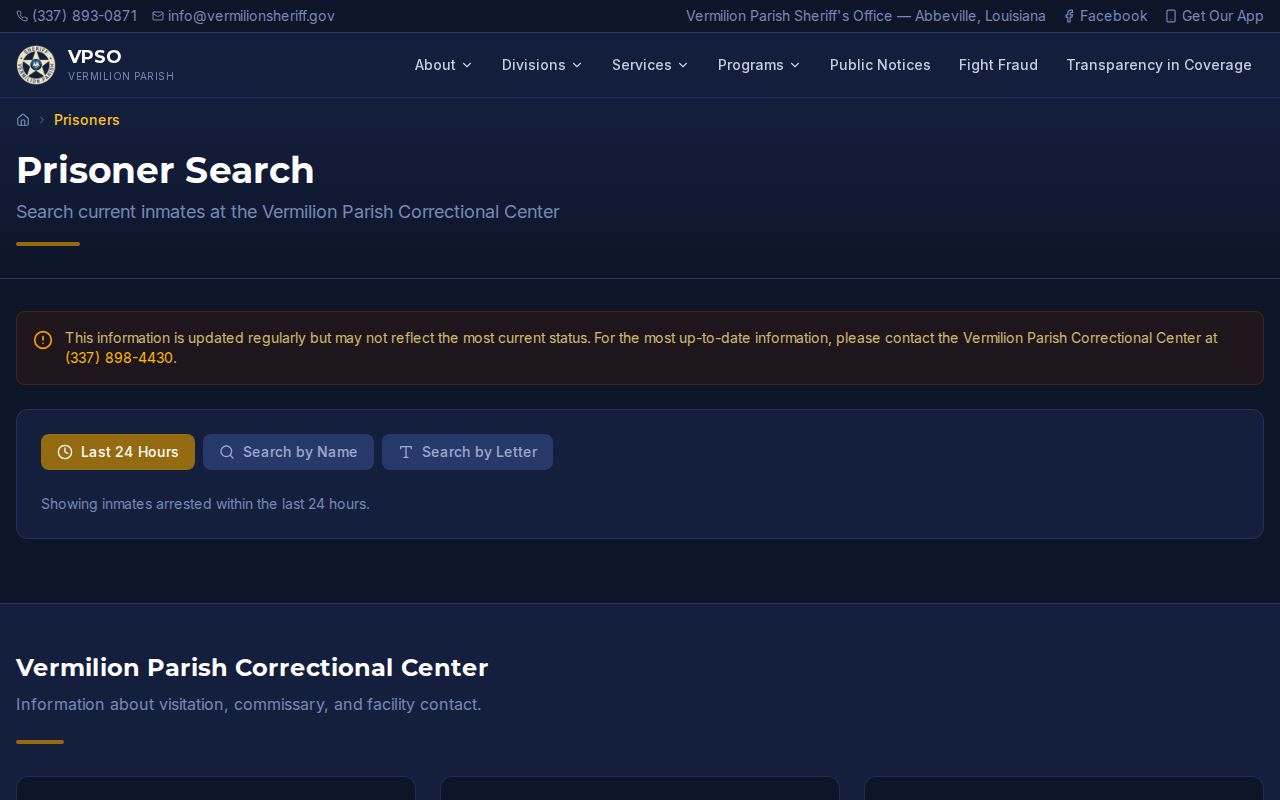
The page also warns that information may not reflect a person's current status and is updated regularly. Keep that caution beside the time-window label.
The St. Mary Parish Sheriff press-release index offers another official example. Each release is dated and states its own period.
Some reports list name, age, city, and arrest time. They may add the charge, the arresting agency or warrant, bond, and a release, summons, or transport note when supplied. Blank fields simply were not supplied.
Note: A dated report stays useful even when its reporting window changes, as long as the date and stated period travel with the record.
What Louisiana Arrest Views Show
Louisiana arrest pages follow no single required display. The fields come from the Vermilion and St. Mary examples and from parish roster patterns, so a given page may show only some of them. One roster shows a booking photo. Another leaves the field blank. The source's own entry describes what it has recorded. Never fill a blank with a guess or assume an omitted field was never collected.
| Field | What it may show |
|---|---|
| Name and age | Identity details supplied in the report or roster. |
| City and time | City, arrest date, booking time, or other event time when published. |
| Charge or charge | The offense wording recorded at booking or in the agency report. |
| Agency and warrant | Arresting agency or a warrant detail when the source includes it. |
| Bond or bail | A bond amount or status, if released by the local source. |
| Release or transport | A release, summons, or transfer note when one is supplied. |
| Photo | A source-specific image, if that parish interface displays one. |
"Bond" is a court-set condition that may allow release while a case is pending. "Booking" is the intake record made after an arrest. A release entry means the source no longer shows the person held. It does not erase the arrest entry or explain the case outcome.
Parish rosters usually show custody status. They rarely log every new arrest. A booking date can help place an entry. Still, a current roster may omit people booked and released. Treat an old booking-history item as history, not a new arrest. When a page gives no clear time window, label it current custody. Do not treat it as a last-day list.
Find Louisiana Arrests Today
Start with the arrest parish. Louisiana's public roster map sits with the Louisiana Commission on Law Enforcement LA VINE roster directory, which lists parish entries and separate municipal systems. Grant, Terrebonne, and Union are marked offline there. An offline link is a service gap, not proof that no one was arrested. For a local destination, the Louisiana County Directory leads to the right parish site. That parish site holds the booking detail.
- Identify the arrest parish. Use the arresting agency, city, or booking location if known. A city arrest may lead to a parish jail record.
- Open the official parish source. Check for a short-period arrest report first. If none exists, use the parish roster as a custody view.
- Read the date and label. Keep “last 24 hours,” “72 hours,” “current,” or another stated period with the result. Do not turn an undated roster into a same-day claim.
- Ask the records custodian if needed. Give the parish, person, approximate arrest date, and any case or incident number. Louisiana’s Public Records Law covers records held by public bodies, subject to limits and exemptions.
When only one person's custody matters, the VINELink Louisiana search is a separate custody and alert system. LA VINE is not a parish arrest log. It is not a court docket either. A result can confirm custody. For a defined booking window, the arrest parish's own report remains the better record. Use both when timing matters.
Note: The LCLE refresh description applies to deployed roster data, not to a promise that a new booking appears within a set number of minutes.
When Louisiana Booking Data Lags
A new arrest rarely hits a public roster right away. Booking, identity review, charge entry, and even release can all finish before the site refreshes. LCLE says its deployed roster data updates every 30 minutes. But that pace sets no uniform arrest-to-posting deadline. A page can also be down or filtered. It may be limited to people still in custody. So search again later. A blank result does not mean the arrest never happened.
Verify before drawing a conclusion: Call the arresting agency or parish jail first. If an entry is missing or unclear, reach its records custodian. An empty search result still leaves room for an arrest that occurred.
For urgent status, compare the parish source with the agency that made the arrest. Was the person booked, released, transferred, or held elsewhere? A court record answers a later question: whether charges were filed and how the case ended. It cannot replace a live custody check. A state corrections locator sits at a different point in the process. It is not a same-day parish roster.
Older postings need wider context. The Louisiana Police Blotter landscape explains dated reports, grouped weekends, and archive limits.
A missing match has many causes. Different spelling. Another agency's hold. Release before the roster refreshed, or a municipal system. Juvenile and protected material is different from ordinary adult booking entries. Search only the permitted fields, and ask the custodian how to make a narrow record request when the site falls short.
Note: Parish pages, booking vendors, and state systems refresh on separate schedules, so a result should carry its source and check time.
Louisiana Arrest Photo Policies Vary
Louisiana parish rosters show no single photo pattern. Caddo and Evangeline post photo-bearing roster and detail views. Others differ. In Bienville, East Carroll, Iberia, St. Landry, and Winn, public interfaces show text-only material or no visible photo. None of this is a legal ruling. A parish with no photo on display may still hold one, and a vendor change can alter what a page shows overnight.
Label what you see. Use "photo shown" or "no photo observed." Mugshot is the wrong default word for every booking entry. Photos can vanish too. A current roster may show an identification photo for someone in custody, and that image can disappear when the record or the source's policy changes. Never copy a juvenile, victim, sealed, or expunged record into a public listing.
Note: A photo's presence on one parish page describes that interface, not a statewide release policy for all Louisiana agencies.
State Police Arrest News Is Selective
Louisiana State Police (LSP) handles news differently. Its newsroom carries releases and enforcement announcements, not a complete daily arrest roster. A release might cover a major investigation, a fatal crash, a fugitive arrest, a multiagency operation, or a public-safety event. LSP posts no public daily arrest log. No complete dispatch log exists either. There is no routine statewide table of every DUI booking. Each release is an event record, not a substitute for the parish source that holds the booking.
When an LSP arrest leads to booking, the person usually goes to a parish jail. Read the release for the named parish and agency. Use that parish's source. The booking record and custody status belong there. A release staying online does not mean the person stays in custody. It may describe an arrest without reporting any later bond, transfer, or court action.
Louisiana Arrests Are Accusations
Charges can change, shrink, or vanish. A roster captures one moment. The disposition shows how the case ended. Keep those two separate. Keep the source date, charge wording, and custody status apart too when details are shared. A same-day arrest view exists to locate an agency record. If a match looks uncertain, ask the issuing agency or court. Do not lean on a photograph, a name match, or a secondhand report. Louisiana's parish-by-parish system makes source labels essential. An official recent report, a current roster, and a news story are different kinds of records. Each has different limits.