
Louisiana Multi-Day Arrest Logs
Louisiana does not run one statewide blotter that lists every arrest in a shared window. Each parish sheriff publishes something different. Some post dated booking reports. Others push news releases about chosen cases or keep live rosters with booking fields. A dated archive might group several days of arrests. A press page shows only the events an agency wanted to announce. A current roster tells you who sits in custody right now. It says nothing about who was booked earlier in the week.
So work source by source. Name where the entry came from, keep its date, and describe its coverage plainly. St. John Parish keeps a dated, paginated archive with weekend-grouped arrest reports. St. Mary Parish has used both 24-hour and 72-hour report language. Rapides Parish offers a press-release archive in a machine-readable format. Each answers a different question. None of them adds up to a complete Louisiana arrest log. None covers the state alone.
Coverage matters: A multi-day page is a batch the source defined for itself. It is not a statewide standard. A missing name proves nothing about whether an arrest happened.
Louisiana Official Blotter Archives
Start with official parish pages before news coverage. Three distinct archive styles appear here. St. John maintains dated posts plus older pages. West Feliciana publishes jail-booking material covering several days. St. Mary stamps each press report with its own window. Trust the date on the original source over a search summary or a reposted snippet.
| Louisiana source | Record pattern | Coverage note |
|---|---|---|
| St. John Sheriff archive | Dated arrest reports, weekend groups, pagination | Older posts are visible, but completeness is not promised. |
| St. Mary Sheriff releases | Dated reports with a stated period | Observed labels include both 24 and 72 hours. |
| West Feliciana bookings | Dated multi-day jail-booking material | Official page; no photo was visible in the reviewed view. |
| Rapides Sheriff feed | Selected press releases in JSON | Machine-readable, but not a full booking log. |
| LA VINE parish rosters | Current adult custody views | Useful fallback, not a dated blotter. |
| Local newspapers | Selected local arrest coverage | Secondary reports require agency verification. |
The St. John Parish Sheriff arrest-reports archive lays out dated arrest reports with older entries and pagination.
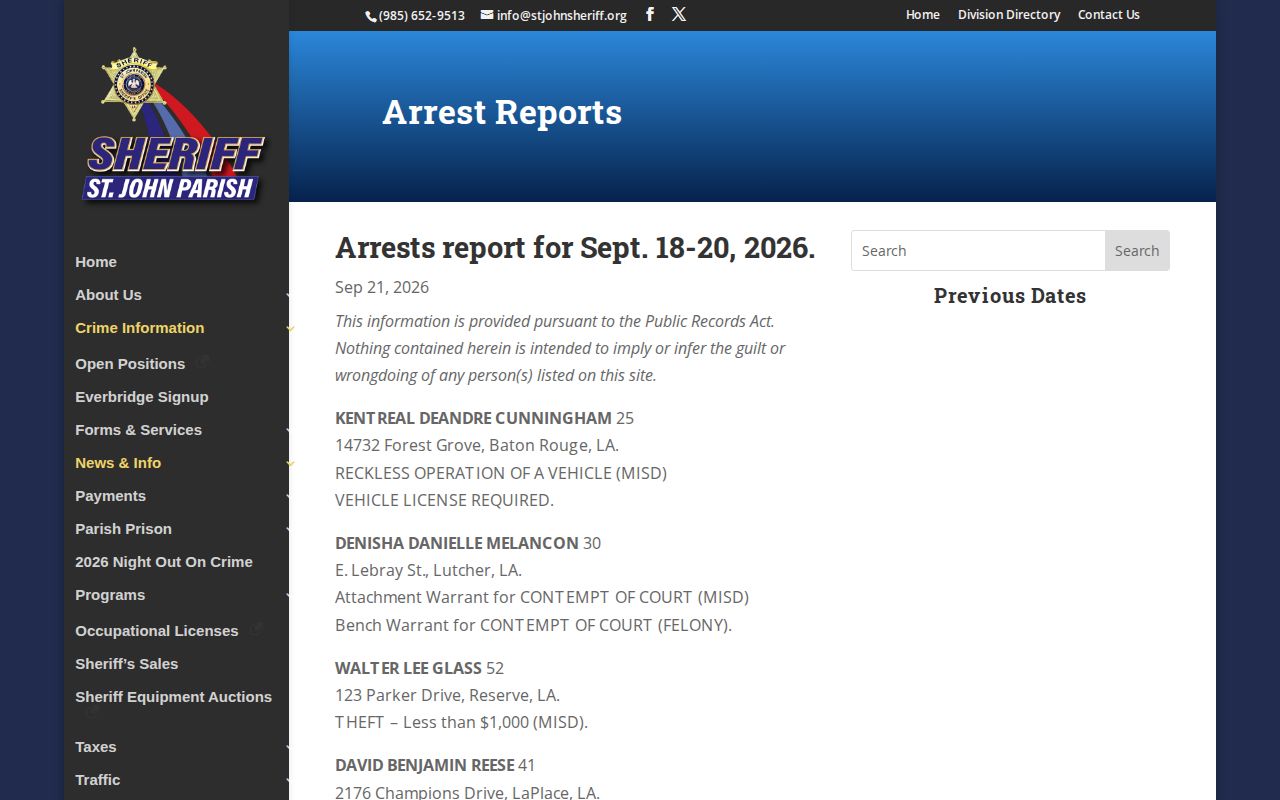
That archive helps you find an arrest report by date. Older pages do not equal a full booking history, though. Keep the dynamic custody roster separate from the dated archive; they are different systems. West Feliciana's official jail bookings page is another dated, multi-day example. Its booking entries appear without photos. That describes the page, not the agency's full record. The St. Mary Sheriff press-release archive shows report windows. Those windows shift over time. Read each release's title and date first. Only then call the batch a daily or weekend log. Note: Pagination and older posts prove an archive exists, not continuous publication or complete booking coverage.
Selected Louisiana Arrest Archives
A machine-readable feed can still be selective. The Rapides Parish sheriff site exposes a JSON press-release collection. It holds roughly 92 objects, dated June 3, 2025 through August 27, 2026. The items cover selected press releases and investigations, not every booking. Sorting a structured file beats scrolling headlines. But format alone does not make a jail log. The Rapides Parish Sheriff press-release feed is the source behind the archive view below.
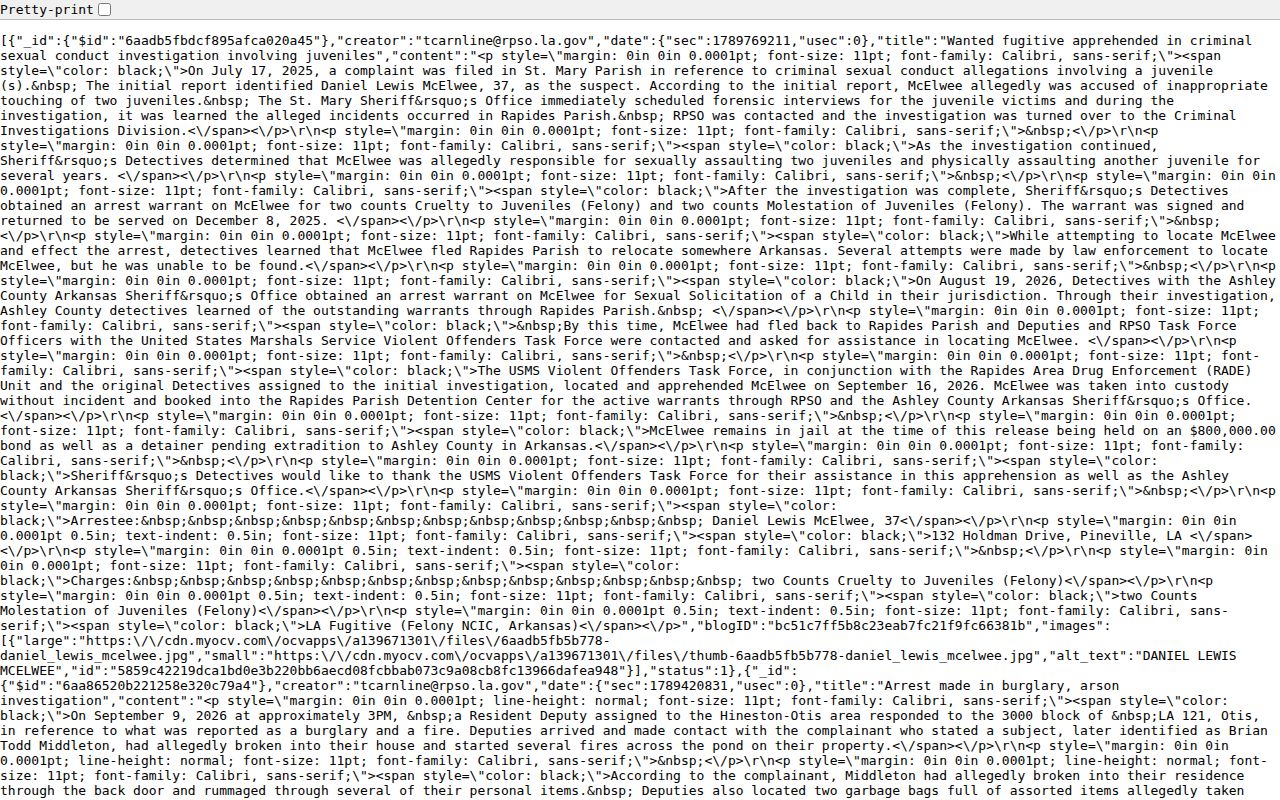
Treat each item as agency news with its own date and subject. A quiet stretch does not mean no arrests occurred. Nor was everyone named in an investigation booked inside the feed's date range. Winn Parish shows a different headache. The sheriff's weekly arrest report route often fails to load. Other times it renders only a JavaScript shell. The Winn Parish Journal carries dated copies of the arrest report. Call the official route unreliable until it works, and mark the newspaper copy as secondary. These examples rule out one statewide claim about archive depth. A source may keep old entries. It may publish only selected news. Or it may stop at a current roster. Today's date range describes that source alone. It promises nothing about permanent access.
What Louisiana Arrest Entries Show
Louisiana blotter entries vary even inside the same parish. A sheriff release may add context and a short narrative. A booking page sticks to the custody event itself. Some entries name the arresting agency or a warrant. Others list bond or a release note. Use only the fields the record supplies, and never fill gaps with details pulled from another person or a secondary source.
| Entry detail | What it tells the reader |
|---|---|
| Report date or period | When the item was posted and which days it says it covers. |
| Name and location | The person named and a city or parish detail when supplied. |
| Arrest or booking date | The event time recorded by that source, which may differ from its post date. |
| Charge or charge | The offense wording reported at arrest or in the release. |
| Agency or warrant | The arresting agency or warrant information if included. |
| Bond, release, or transport | A custody note supplied in the report, not a court outcome. |
| Photo | An image only when the official page displays one. |
A “post date” is when an item appeared online. An “arrest date” is the event date stated in the record. Those may not match. Booking is the intake record created after an arrest. A bond entry is not a verdict. A case disposition is the court’s later outcome, such as dismissal, plea, or judgment. The clerk record, not the blotter headline, answers that question.
Use source labels such as “official dated booking report,” “selected press release,” “current custody roster,” or “secondary newspaper report.” That small distinction prevents a news item from being mistaken for a complete intake record. It also helps when an old archive entry remains visible after custody has changed.
Find a Louisiana County Blotter
Start with the parish tied to the arrest. The city or arresting agency identifies the right jail or sheriff. The Louisiana County Directory routes to parish sites. There a reader can look for a booking archive, a news page, or a public-records contact. One caution applies. A city police log and a parish jail record may cover different people.
- Open the official parish source. Look for a dated arrest report, jail-booking archive, or press-release page. Record the page title and agency name.
- Check its date range. Note the report date and any stated period, such as a multi-day or weekly batch. Keep that wording with the record.
- Separate the record types. A current roster shows who appears in custody; a dated blotter shows what its publisher chose to report; a clerk docket shows court action.
- Request a missing older record. Contact the current records custodian with the person, parish, approximate date range, and incident or case number if known.
Some searches only need the latest intake period. Louisiana's Arrests Last 24 Hours landscape separates short-window views from current custody lists. The wider archive still has a job. It works for a weekend arrest group, a dated press item, or a record no longer on a live roster.
Weekend Arrest Reports in Louisiana
Each publisher sets its own weekend and holiday coverage. St. John's archive shows a sheriff grouping several days into one dated post. St. Mary's shifting period labels tell another story. Read the report title instead of assuming equal coverage. Local papers often post after a weekend rather than at each booking. A Monday item may cover any period the agency chose. Take the date range from the item itself.
Weekend caution: a quiet weekend page or a Monday post is not a count of every booking. Check the stated coverage with the sheriff or jail.
A delayed batch can include people already released. Bond is a court-set condition for release. Someone can leave custody before a weekly page appears. An old report is therefore no live custody check. A transfer can also move a person to another parish or facility.
Compare two dates whenever both are available. One is the event date in the entry, the other the publication date of the post. If a page shows a single date, call it the page's date. Do not claim it as the arrest time. Keep the arrest, the custody status, and the case outcome distinct in any summary.
Note: Weekend grouping is a publishing choice, so preserve each parish source's own date span rather than applying one shared calendar rule.
Louisiana State Police News Items
Louisiana State Police (LSP) posts news about selected enforcement events. It is not a daily statewide arrest log. The official LSP newsroom may report a fugitive arrest, a crash investigation, a multiagency operation, or a public-safety action. No routine table lists every DUI booking. A release can add context while omitting ordinary arrests.
When LSP makes an arrest, the booking record may sit with a parish jail. Follow the agency and parish named in the release to the local custody or booking record. An LSP story is not a full arrest history. Not every state-police arrest gets a public news release. A state police event story and a parish blotter serve different purposes.
Ouachita Parish Sheriff's Office runs an official news feed. That feed is not a complete multi-day arrest blotter. The label "official" names the publisher. It does not guarantee a full roster.
Local Louisiana News Blotters
Local newspapers can preserve a dated arrest report when an official page is hard to search. The Bienville Parish Journal runs steady local coverage. The Pointe Coupee Banner has run arrest-log items. And St. Bernard News' arrests archive groups its local stories. These are news sources, not government rosters. Coverage can be selective, and pages may miss bookings.
A paper also serves as a backup copy when a sheriff's weekly page will not load. Read the byline, the date, and any correction note. Then compare a named arrest with the originating sheriff or court. An article can report a charge. It rarely shows how the case later ended.
Treat news pages as discovery leads after official sources. A report may quote a sheriff's office or describe a selected enforcement action, but the agency's own record remains the better source for an arrest date or booking field. Contact the publisher's correction desk with the specific fact and the supporting record. A correction request does not guarantee removal of a story or a copy elsewhere.
Louisiana Older Arrest Records
How far back a Louisiana blotter goes depends on the parish. St. John keeps dated older entries with pagination. The Rapides press archive holds only a limited set of items. A jail vendor might show a brief booking history. Pages can vanish when an agency changes its records policy or software. Sheriffs, police departments, state agencies, clerks, and records vendors may all hold older arrest material. No statewide date guarantees that every parish blotter stays online. The Louisiana State Archives retention schedules show how this works, since each schedule is agency-specific. Agencies submit schedules for approval and renewal. They list their record series and flag confidential material. They also get authorization before destroying anything. Photographs and electronic records count as records under these schedules.
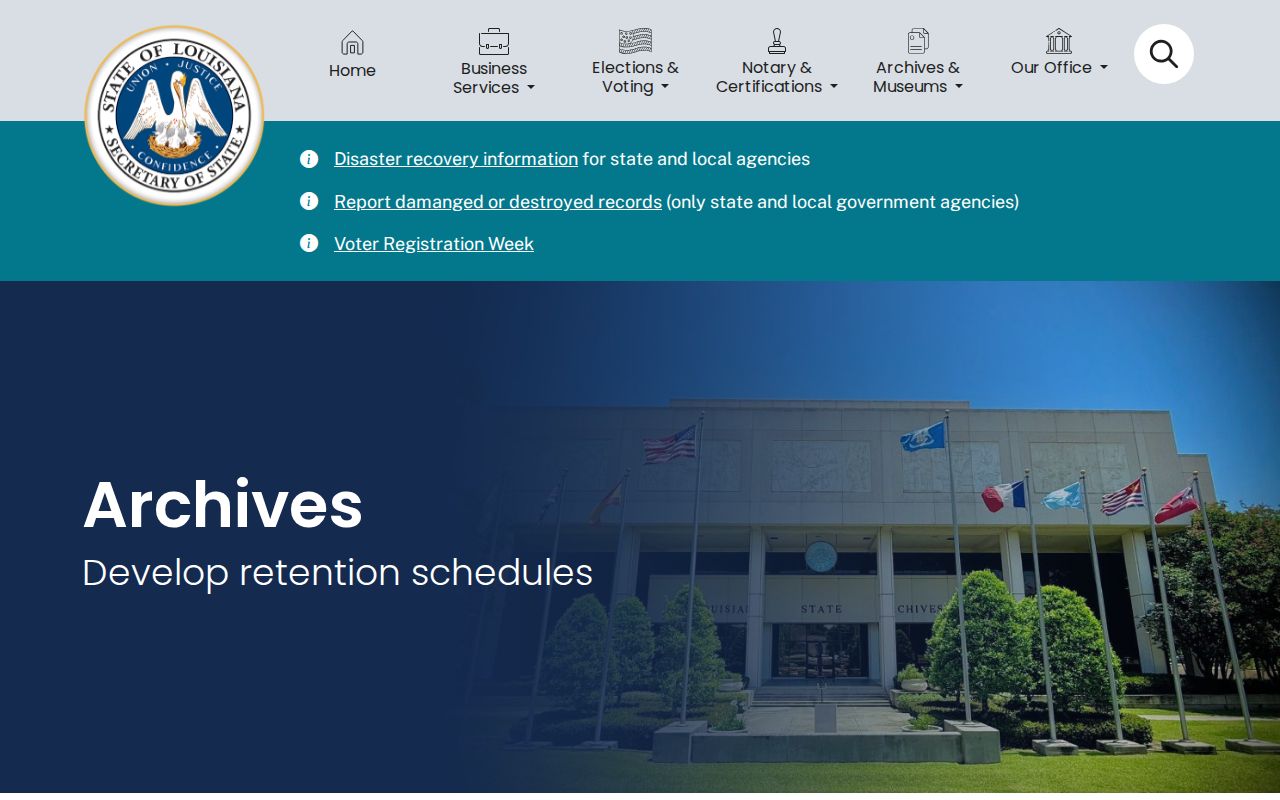
A schedule tells you how an agency manages a record series. It cannot confirm that a specific booking entry still exists. Nor can it confirm the Archives holds it. For a recent parish arrest, start with the sheriff or the police records custodian. A state record may have moved. In that case, Archives staff can help pinpoint the schedule, collection, or historical transfer involved.
Request path: Give the agency, the person's name, the approximate event date, the parish, and any case or incident number. Then ask directly whether the record stays with the custodian, was destroyed under an approved schedule, or was transferred elsewhere.
The State Archives Records Management program advises agencies on retention and disposal. The Records Center stores eligible inactive state-agency material. The depositing agency keeps ownership and controls access. A current parish jail record should not go to the State Archives by default.
For archival research, bring a name or agency. Bring a date span. Add the record series as well. Include the parish or facility, and any collection or box detail you already know. The Archives publishes research and reproduction fees for some services. Staff work may depend on identifying a collection or pulling inactive material. For a current or recent arrest, request the record from the public body that created or holds it. Then ask which public-records process applies.
Note: An older arrest report may be offline even while the agency still holds it, so ask the current custodian before treating a blank archive as final.
Louisiana Arrest Logs Are Allegations
A police blotter captures an arrest or an agency report. A later clerk record may show the outcome of the case. Charges can change, be reduced, or be dismissed.
Keep the source, date, and stated coverage attached to each entry. Never merge an official booking report with a secondary article. The two are not one file. Louisiana's multi-day archive mosaic stays useful only under one condition. Each piece must remain tied to the agency or publisher that created it.